Nightingale Nest
Explore our rooms for information, curriculum maps and home learning.
Welcome to EYFS
Early Years Foundation Stage
As partnership schools, Drayton Community Infant School and Nightingale Infant School work closely together to share expertise and best practice across the Early Years Foundation Stage (EYFS).
At Nightingale, our Early Years provision includes two Reception classes, Robin A and Robin B, and two Nursery classes: Wren, for children aged 2–3, and Wagtails, for children in the year before Reception.
Our Reception children benefit from a free flow environment, enabling them to move between the two classrooms and outdoor learning spaces. This gives children opportunities to learn through play, follow their interests, develop independence and build positive relationships with others.
Our EYFS Curriculum
Our curriculum is designed around the seven areas of learning and development in the EYFS Statutory Framework. We provide a balance of child-initiated and carefully planned adult led learning, recognising that young children learn best through meaningful experiences, high-quality interactions and purposeful play.
Our curriculum aims to develop confident, curious and resilient learners who are ready for the next stage of their education. We focus on the Characteristics of Effective Teaching and Learning:
- playing and exploring.
- active learning; and
- creating and thinking critically.
We use observations, interactions and assessment to understand each child’s development and plan experiences that build on what they already know and can do.
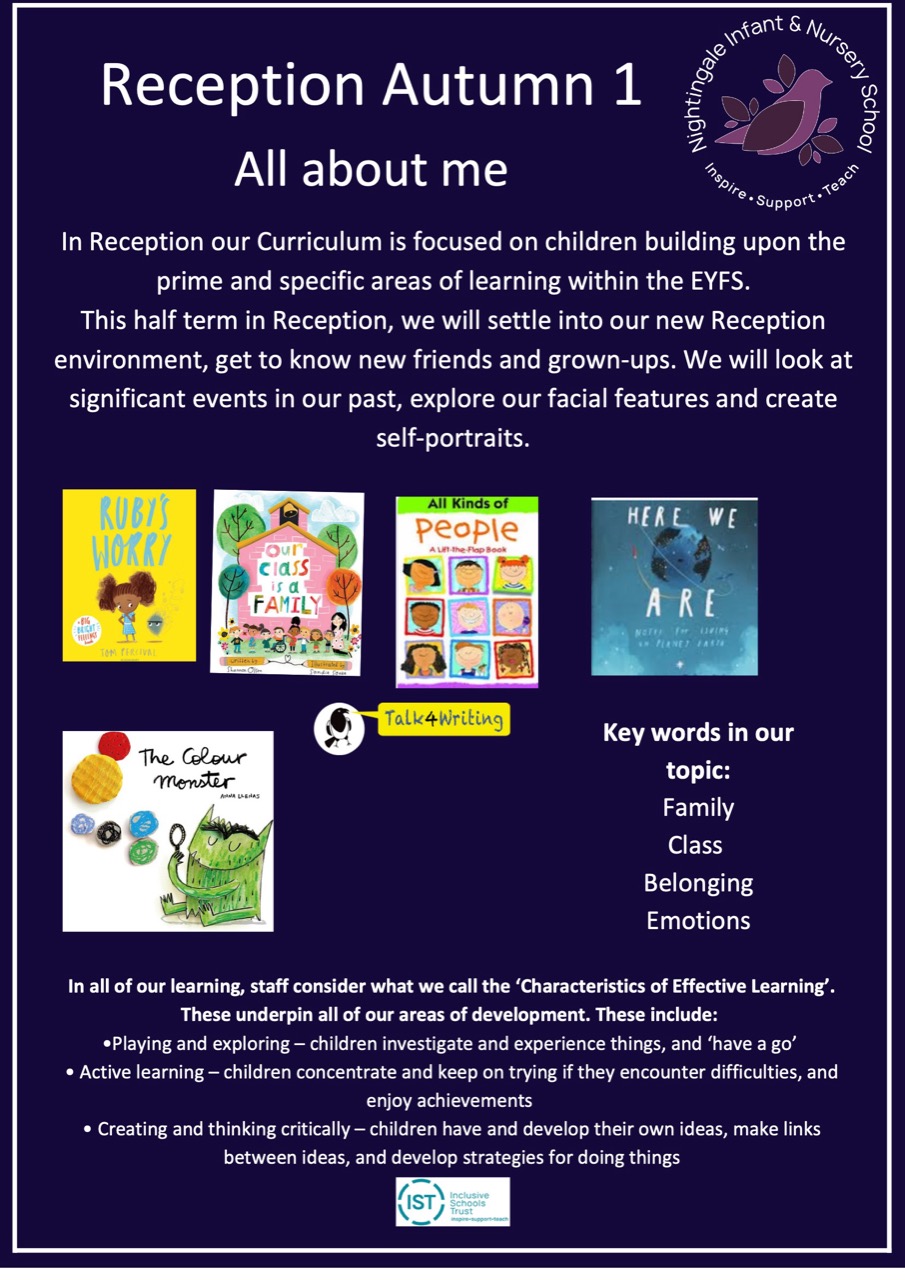
Our topics are brought to life through high-quality children’s literature, supporting language, communication, vocabulary and a love of reading. Phonics is taught daily through Little Wandle Letters and Sounds Revised, while mathematics is taught through a mastery approach, developing secure foundations in number, numerical patterns, shape, space and measure.
Children also benefit from visitors, trips, special events and experiences that enrich our curriculum and connect their learning to the wider world.
Learning Through Play and Our Environment
Our indoor and outdoor environments are carefully planned to provide rich opportunities across all seven areas of learning. Continuous provision is enhanced in response to children’s interests, developmental needs and current learning.
Our outdoor provision includes opportunities for:
- physical development and fundamental movement skills;
- construction and problem-solving;
- sand, water and sensory play;
- gardening, planting and observing the natural world;
- mark-making, reading and storytelling;
- music, creativity and imaginative play; and
- developing independence, cooperation and risk awareness.
We value the importance of being active and learning outdoors in all seasons. Children are supported to develop healthy habits, care for their environment and understand the world around them.
Health, Nutrition and Wellbeing
Supporting children’s physical and emotional wellbeing is an important part of our EYFS provision.
We encourage children to develop healthy habits through active play, good hygiene, rest, positive relationships and healthy eating. Food and mealtimes provide opportunities to develop independence, social skills and an understanding of healthy choices.
We follow current EYFS food and drink requirements and government healthy eating guidance, providing nutritious food and drink appropriate to children’s age and developmental needs. We support children to explore a variety of foods and develop positive attitudes towards healthy eating, while taking account of individual dietary, allergy and cultural requirements.
Children have regular opportunities to access drinking water and are encouraged to recognise and respond to their own needs.
A Typical Day
Our daily routine provides a balance of adult-led learning, small-group activities and child-initiated learning.
Whole-class sessions introduce children to new knowledge, stories, vocabulary and skills. During Choose Our Own Learning (COOL) time, children select from a range of carefully planned experiences and continuous provision. Adults observe, interact, question and model language and skills, extending learning when appropriate.
Predictable routines help children feel secure and develop independence, while flexibility allows practitioners to respond to children’s interests and emerging learning.
Parents as Partners
We recognise that parents and carers are children’s first and most important educators. Strong partnerships between home and school help us understand each child and provide consistent support for their development.
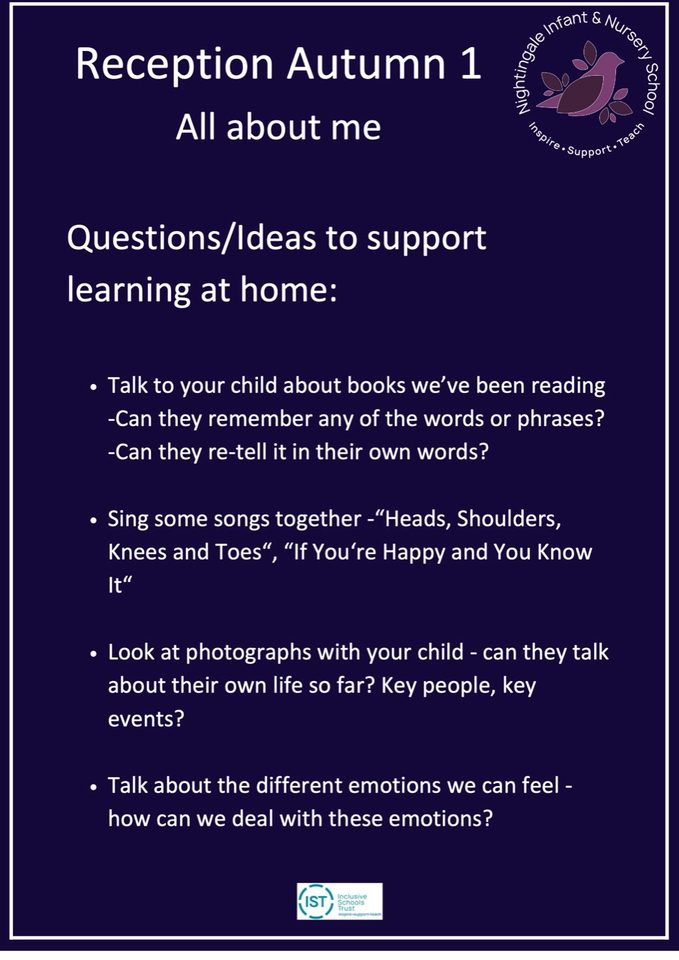
We use Tapestry to share children’s learning and achievements and encourage families to contribute experiences and interests from home. We also provide opportunities for parents and carers to visit school, learn more about our curriculum and find practical ways to support learning at home.
By working together, we can help every child develop the knowledge, skills, confidence and positive attitudes they need to flourish throughout their education and beyond.
EYFS Parent Plans and Home Learning
Autumn 1 2026