At Nightingale Infant and Nursery School, we believe every child has the right to achieve their full potential in a caring, inclusive and supportive environment. We are committed to identifying and responding to the individual needs of our pupils, ensuring that children with Special Educational Needs and Disabilities (SEND) receive the high-quality teaching, personalised support and opportunities they need to thrive academically, socially and emotionally.
We work closely with pupils, parents, carers and external professionals to identify needs early, remove barriers to learning and promote independence. Through our graduated approach to SEND, we regularly review each child’s progress and adapt provision to ensure they receive the support they need. We value every child as an individual and are committed to creating a school where everyone feels safe, respected and included.
Our SENDCO

Mrs Findlay
If you have any questions or queries relating to SEND Please contact her via the school office officenightingale@istnorfolk.
Interventions
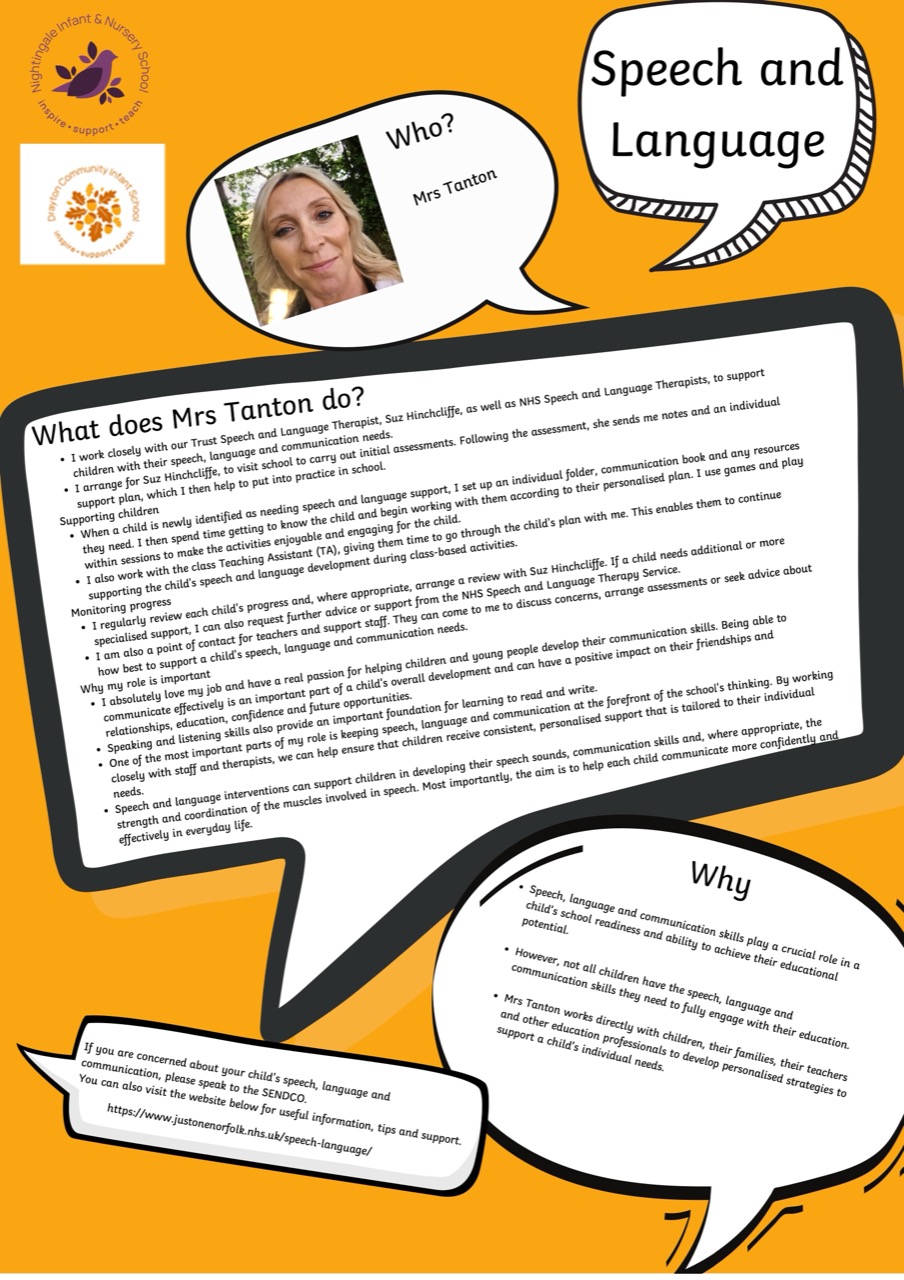
SALT- Speech and Language Support- Speech TA Mrs Tanton
At Nightingale Infant and Nursery School, we recognise that communication is key to learning, developing friendships and building confidence. We provide a range of speech and language support to help children develop their communication skills and reach their full potential.
We are fortunate to have access to a dedicated Trust Speech and Language Specialist, alongside Teaching Assistants who deliver targeted speech and language interventions. We also work closely with NHS Speech and Language Therapists to ensure children receive consistent support both in school and at home.
What support might include:
- Understanding and following instructions
- Developing vocabulary and sentence building
- Speech sound development
- Listening and attention skills
- Social communication and interaction
What do sessions look like?
Sessions are delivered individually and may include:
- Language games and activities
- Storytelling and vocabulary work
- Speech sound practice
- Listening and attention tasks
- Social communication activities
Why is Speech and Language Support Important?
Strong communication skills help children to:
- Access learning across the curriculum
- Express their thoughts, feelings and needs
- Build positive relationships
- Develop confidence and independence
By working together with families and professionals, we ensure that every child receives the support they need to become confident and successful communicators.
DESTY (Discovering Exceptional Strengths and Talents in You) – Run by Mrs Wilson
At Nightingale Infant and Nursery School, we are committed to supporting children’s emotional wellbeing and helping them develop the confidence and resilience they need to thrive. DESTY (Discovering Exceptional Strengths and Talents in You) is a nurturing intervention that helps children understand their feelings, build positive relationships and recognise their own strengths.
DESTY provides children with dedicated time alongside a trusted adult to explore emotions, develop coping strategies and build emotional resilience through engaging and child-friendly activities.
What can DESTY support with?
DESTY may help children to:
- Build confidence and self-esteem
- Develop emotional resilience
- Understand and manage their feelings
- Develop positive friendships and social skills
- Improve emotional regulation
- Cope with change, loss or difficult experiences
- Build trusting relationships with key adults
- Recognise and celebrate their strengths and achievements
These are key areas that the DESTY programme is designed to develop through positive relationships and emotional literacy work.
What do sessions look like?
DESTY sessions are fun, engaging and tailored to each child’s individual needs. Activities may include:
- Talking about feelings and emotions
- Stories and discussions
- Games and interactive activities
- Creative tasks and drawing
- Reflection activities
- Building confidence and identifying personal strengths
- Problem-solving and friendship activities
Children work in a calm, safe environment where they can feel listened to, valued and supported.
Our DESTY Programme
The DESTY Island programme is usually delivered over an average of 14 guided sessions, with each session lasting around 30-40 minutes and taking place one-to-one with a trained adult mentor.
Working Together
We know that children make the best progress when home and school work closely together. Throughout the DESTY programme, we will share updates and celebrate successes with families.
DESTY is not a counselling or therapy service. It is a school-based intervention designed to provide children with positive support, helping them develop emotional resilience, confidence and the skills they need to flourish both in school and beyond.
If you would like to find out more about DESTY, please speak to Mrs Wilson or Mrs Findlay our SENDCO via the school office.
ELSA (Emotional Literacy Support Assistant) Intervention – Run by Mrs Woods
At Nightingale Infant and Nursery School, we understand that children sometimes need a little extra support to help them understand and manage their feelings. Our ELSA (Emotional Literacy Support Assistant) programme provides gentle, nurturing support for children who may benefit from developing their emotional wellbeing, confidence, resilience, friendships, or social skills.
ELSA sessions are delivered in a safe, supportive environment where children can talk, play, learn, and explore emotions through carefully planned activities tailored to their needs.
What does ELSA support with?
ELSA can help children with:
- Understanding and expressing feelings
- Building self-esteem and confidence
- Friendships and social skills
- Managing worries and anxieties
- Emotional regulation
- Coping with change and transitions
- Developing problem-solving skills
- Understanding and managing behaviour
What do sessions look like?
Sessions are designed to feel positive, engaging, and child friendly. Activities may include:
- Games and role play
- Stories and discussions
- Creative activities such as drawing or crafts
- Emotion-focused tasks
- Relaxation and mindfulness activities
- Friendship and social skills activities
Children attend individual or small group sessions and are encouraged to share their thoughts and feelings in a way that feels comfortable for them.
Our ELSA Programme at Nightingale
Children access ELSA support through a structured programme that runs across a school term.
Week 1-2 – Getting to Know Your Child
- Initial session to build trust and develop a positive relationship.
- Baseline information gathered.
- Individual targets identified.
Weeks 3–6 – First Intervention Block
- Four weekly ELSA sessions focused on agreed targets.
- Activities tailored to support your child’s emotional needs.
Week 7 – Parent Update
- A review of progress so far.
- Parents/carers receive feedback.
- Opportunities to discuss ways to support at home.
Weeks 8–11 – Second Intervention Block
- A further four weeks of targeted ELSA support.
- Children continue working towards their identified goals.
Week 12 – Final Review
- Progress reviewed against initial targets.
- Parents/carers receive a summary report.
Working Together
Parents and carers play an important role in supporting emotional wellbeing. Throughout the ELSA programme, we aim to work closely with families to share progress and celebrate successes.
Please remember that ELSA is not a counselling service or therapy. It is a school based emotional support intervention designed to help children develop the skills and confidence they need to thrive both in school and beyond.
If you would like to find out more about ELSA, please speak to your child’s class teacher, Mrs Woods or our SENDCO Mrs Findlay. You can contact them via the school office officenightingale@istnorfolk.
Sensory Circuits – Interventions run by Mrs Middleton and Miss Bell
At Nightingale Infant and Nursery School, we recognise that children learn best when they feel calm, regulated and ready to learn. Sensory Circuits are a simple and effective programme designed to help children achieve the right level of alertness and focus for learning.
Sensory Circuits are based on the understanding that some children need movement and sensory activities to help organise their brains and bodies. These activities can help children who are feeling over-excited, anxious, tired, restless or distracted, enabling them to better engage with learning throughout the school day.
Why do we use Sensory Circuits?
Sensory Circuits can help children to:
- Improve concentration and attention
- Develop self-regulation skills
- Support emotional wellbeing
- Increase readiness for learning
- Improve coordination and motor skills
- Reduce feelings of anxiety or restlessness
- Support transitions throughout the school day
- Build confidence and independence
While some children benefit from targeted sensory support, many sensory activities are beneficial for all children and form part of our inclusive approach to meeting children’s needs.
What do Sensory Circuits look like?
Sensory Circuits use a series of fun, movement-based activities that are designed to prepare children for learning. Activities may include:
- Jumping
- Balancing
- Crawling
- Pushing and pulling
- Throwing and catching
- Spinning and stretching
- Obstacle courses
- Fine motor activities
The activities are carefully chosen to help children become alert, organised and ready to engage in classroom learning.
How are Sensory Circuits used at Nightingale Infant and Nursery School?
Sensory Circuits are embedded throughout our school day in addition to specific interventions and are available to all children as needed.
All staff have received training in delivering sensory regulation activities and use these strategies daily to support children both in and out of the classroom. Sensory activities may be used:
- At the start of the school day
- Before focused learning tasks
- Following lunch or playtimes
- During transitions
- When a child needs support to regulate their emotions or attention
This whole school approach, which was introduced in October 2026, ensures that children receive consistent support and helps create a calm, positive learning environment where every child can thrive.
Working Together
Every child has unique sensory needs. By providing opportunities for movement and sensory regulation throughout the day, we help children develop the skills they need to manage their emotions, focus their attention and access learning successfully.
If you would like to find out more about Sensory Circuits and how they support your child, please speak to Mrs Findlay our SENDCO.
Gym Trail Intervention- Run by Mrs Middleton and Miss Bell
At Nightingale Infant and Nursery School, the Gym Trail is a targeted intervention designed to support children who may need additional help with their physical development, coordination, balance and sensory processing skills.
The intervention provides structured opportunities for children to practise key movement skills in a supportive environment, helping them develop the physical foundations needed for learning and everyday activities.
What does the Gym Trail support?
- Balance and coordination
- Core strength and stability
- Gross motor skills
- Spatial awareness
- Motor planning
- Confidence and independence
- Sensory regulation and body awareness
What do sessions look like?
Children follow a planned sequence of activities which may include:
- Climbing
- Balancing
- Crawling
- Jumping
- Hopping
- Navigating obstacle courses
Activities are carefully selected and adapted to meet individual needs and targets.
Why do we use the Gym Trail?
Strong physical development supports many areas of learning, including handwriting, concentration, self-care skills and participation in classroom activities. The Gym Trail helps children develop the strength, coordination and confidence they need to successfully access school life.
The intervention is delivered by trained staff and progress is monitored to ensure children are developing the skills needed to achieve their individual goals.
Bucket Time- Delivered by Mrs Bright, Mrs Middleton and Mrs Dingle
At Nightingale Infant and Nursery School, we use Bucket Time to help children develop their attention, listening and communication skills in a fun and engaging way.
Bucket Time is a structured intervention that uses motivating activities to encourage children to focus, concentrate and join in with group activities. It is particularly beneficial for children who may find it difficult to maintain attention, follow routines or engage with others.
What does Bucket Time help with?
- Attention and concentration
- Listening skills
- Following instructions
- Turn-taking
- Social interaction
- Communication and language development
- Readiness for learning
What do sessions look like?
Bucket Time sessions are highly visual, interactive and exciting. Children take part in a series of short activities designed to capture their interest and gradually increase their attention span. Activities may include:
- Sensory experiences
- Cause-and-effect toys
- Interactive games
- Creative and practical activities
- Turn-taking opportunities
Why do we use Bucket Time?
By developing attention and listening skills, children are better able to access learning, participate in classroom activities and interact positively with others. These skills provide an important foundation for communication, learning and social development.
Sessions are delivered by trained staff and are tailored to meet the needs of the children taking part.